
The far-right Alternative for Germany (AfD) has secured a decisive victory in the eastern state of Saxony-Anhalt, winning 43.8% of the vote but falling short of the absolute majority required to govern alone.
According to preliminary results, the AfD more than doubled its performance from the 2021 election, finishing well ahead of the conservative Christian Democratic Union (CDU), which dropped by more than half to 17.2%. Voter turnout in the state of 2.1 million reached 77.8%.
Projections indicate the AfD is on track to take 39 seats in the 83-seat state parliament, three short of the 42 required for a majority. No far-right party has led a German state administration since World War Two. A state government holds significant domestic authority, including control over regional policing, education, and cultural policy.
Coalition Obstacles and Leadership Stance
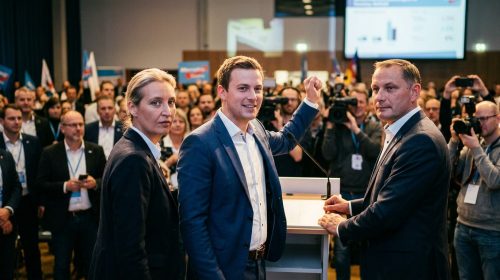
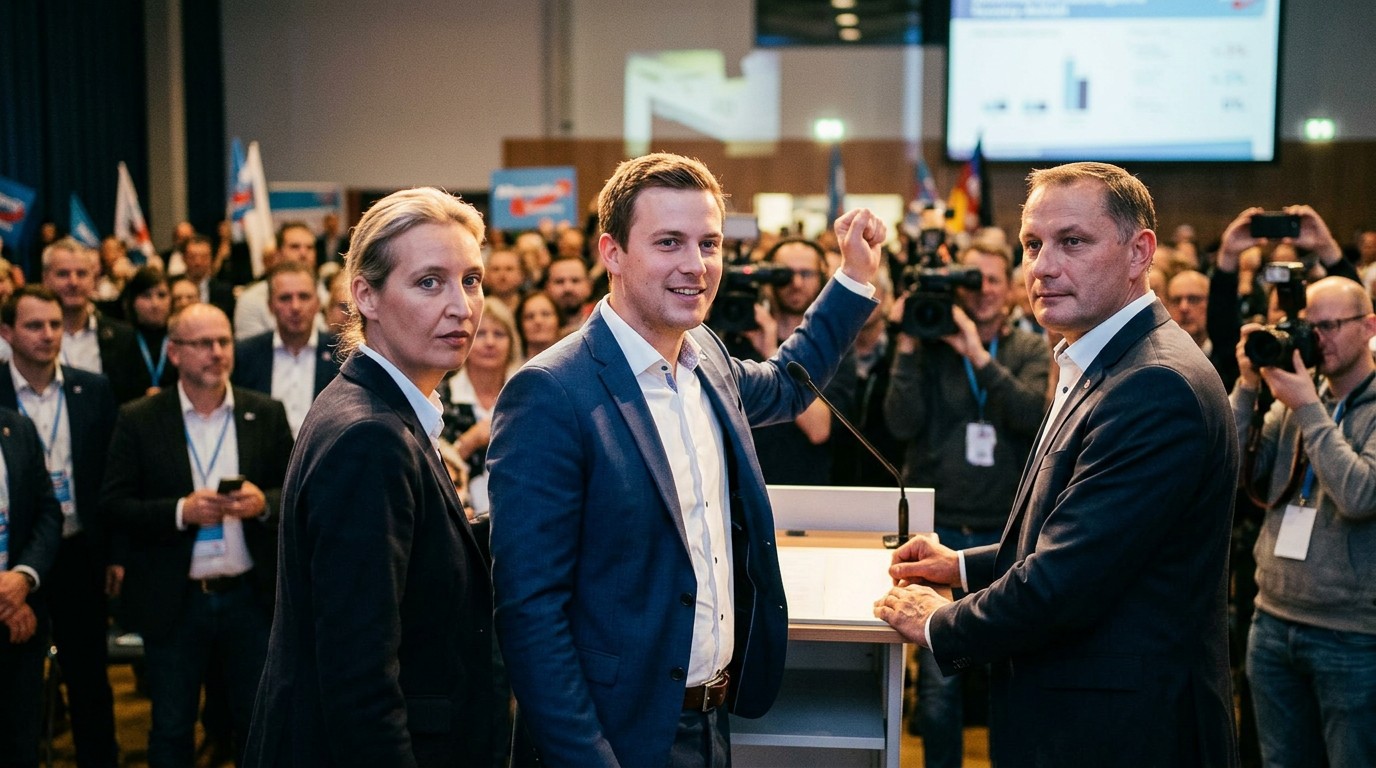
The AfD’s 35-year-old state leader, Ulrich Siegmund, described the outcome as “sensational” and claimed a mandate to govern, celebrating alongside joint national party leaders Alice Weidel and Tino Chrupalla.
“This isn’t just about Saxony-Anhalt,” Siegmund told supporters. “It’s a signal for the whole of Germany – a self-confident signal.”
Mainstream parties in Germany maintain a “Brandmauer,” or firewall, refusing to enter coalitions with the AfD. Saxony-Anhalt’s domestic intelligence agency classifies the local AfD branch as “right-wing extremist,” a designation Siegmund rejects.
While the AfD’s national leadership has considered the option of a minority administration, Siegmund has so far resisted the prospect.
“If necessary there’ll just be new elections, then we’d just get 50 or 55%,” Siegmund said, adding that he remained open to working with individual lawmakers or parties.
The left-wing populist Bündnis Sahra Wagenknecht (BSW) won five seats after narrowly passing the threshold to enter parliament. The BSW, which shares hardline stances on migration and supports importing Russian gas, has left the door open to cooperating with the AfD on select policies.
Domestic and International Reactions
CDU state leader Sven Schulze conceded defeat following the sharp drop in his party’s support.
“This was an extremely tough and intensive election campaign,” Schulze said, stating that the conservatives must confront the outcome.
Lars Klingbeil, national leader of the centre-left Social Democratic Party (SPD)—which governs at the federal level alongside Chancellor Friedrich Merz’s CDU—labeled the result “truly dramatic” and called it a “signal to Berlin” that the federal government would hear.
Charlotte Knobloch, the 93-year-old Holocaust survivor and leader of the Jewish community in Munich and Bavaria, expressed deep alarm and called on mainstream parties not to allow “this decline.”
“On days like this I find it hard to recognise my homeland any more,” Knobloch said.
The regional election drew swift international commentary:
- United States: President Donald Trump shared a screenshot of the German election projection on Truth Social. Vice-President JD Vance had previously endorsed the AfD ahead of Germany’s federal election last year, drawing accusations of foreign political interference from German critics.
- Russia: Russian presidential envoy Kirill Dmitriev shared Trump’s post and hailed a “historic win for the pragmatic AfD,” having previously described the party as “the party of hope and reason, co-operation truth and hope for Germany.”
- Poland: Centre-right Prime Minister Donald Tusk condemned the outcome, stating that “in Poland only idiots and traitors can rejoice at the triumph of the AfD.”
Broader Political Context
The AfD leads nationwide opinion polls ahead of the governing CDU and SPD, drawing its strongest base from eastern states. The party won a state election in neighboring Thuringia in 2024 but was locked out of power after rivals refused to form a coalition.
The party has faced intense scrutiny over its platform, including a controversial concept of “remigration.” While critics describe the policy as mass deportations, the AfD asserts it applies specifically to criminal and irregular migrants. State governments lack the jurisdiction to execute such federal-level migration overhauls.
Regional party figures have also faced criticism over historical and foreign policy matters. The state AfD has attacked the Dessau-based Bauhaus design school—shut down by the Nazi regime in 1933—calling it “the dead-end of modernism.” Separately, senior state AfD figure Hans-Thomas Tillschneider dismissed criticism regarding a Russian military mug displayed in his office, characterizing it as a souvenir and stating, “it’s not our war.”
Public opinion remains sharply polarized. At an anti-AfD “Democracy Festival” in Magdeburg on the eve of the election, a demonstrator named Nikita urged Germans to “learn from our history and not go back. We don’t want the dark times any more.”
Conversely, AfD voters at the party’s election gathering cited economic and security anxieties. A voter named Bert expressed concern for his three children, stating, “I’m in fear, I’m really in fear that safety erodes more and more.” Another supporter, Ollie, called the AfD “a party for the working people” and “the alternative for Germany.”
Source: BBC News — https://www.bbc.com/news/articles/cy4zejgz3z9o