

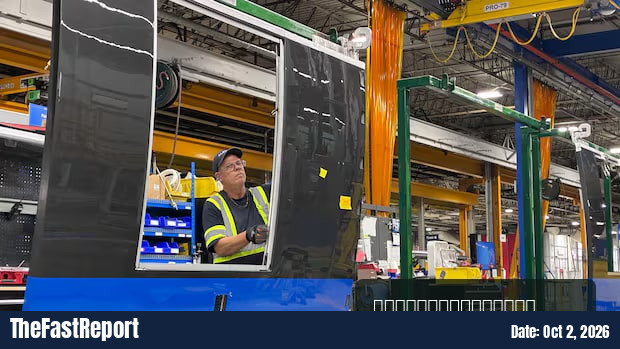
For Claude Michaud, the increasingly loud buzz of machinery and welding at the train factory where he has worked for much of the past 34 years is a source of optimism. The Alstom plant in La Pocatiere, Quebec, a community of about 6,000 people, has endured waves of layoffs and uneven production over the past two decades. Amid a wave of new Canadian projects, the plant is expanding its factory floor and preparing to hire more staff. Michaud, the union president whose father, spouse, father-in-law, brother-in-law, and niece have all worked at the plant, noted that there is deep pride in building trains at home for Canadians. Alstom, a French company whose Americas headquarters is in Saint-Bruno-de-Montarville, Quebec, completed its acquisition of Bombardier’s rail-building division in 2021. The firm is seeing a rise in orders following a push by all levels of government to buy Canadian. The facility is currently building rail cars for Vancouver’s SkyTrain, subway trains for the Toronto Transit Commission, and vehicles for a new Quebec City tramway. It will soon begin work on a $4.7-billion contract to build long-distance passenger cars for VIA Rail. Located 140 kilometres northeast of Quebec City, the plant has long been one of the region’s largest employers and an economic driver, but it previously became heavily dependent on U.S. export projects. The number of employees at the plant dropped from more than 1,000 in the 1990s to about 150 in 2021, threatening its economic viability. Now, there are about 550 employees, and the company is preparing to grow further. Olivier Marcil, Alstom’s vice-president of public affairs for Canada, explained that increasingly protectionist manufacturing policies in the U.S., such as the Federal Transit Administration Buy America policy, effectively closed the door to the southern market by raising domestic component thresholds. Marcil emphasized that Canada must mirror these measures to nurture its domestic industry. Dan Breznitz, a professor at the University of Toronto’s Munk School of Global Affairs and Public Policy, noted that restoring rail manufacturing involves challenges, particularly because a hiatus of 20 to 30 years can lead to a loss of essential skills and local supply chains. Frédéric Platteeuw, Alstom’s site manager in La Pocatiere, stated that the facility is undergoing a major transformation to adapt for the VIA Rail project, which will generate manufacturing work for nearly a decade alongside a 15-year support agreement. The new cars will be built in La Pocatiere with final assembly in Thunder Bay. For employees, the robust pipeline marks a welcome shift after years of advocating for Canadian-content requirements, especially following a painful 2018 blow when a VIA Rail fleet contract went to Siemens to be built in California. Michaud expressed relief that the government is finally listening, highlighting that money invested locally stays within the country.
Source: cbc.ca