
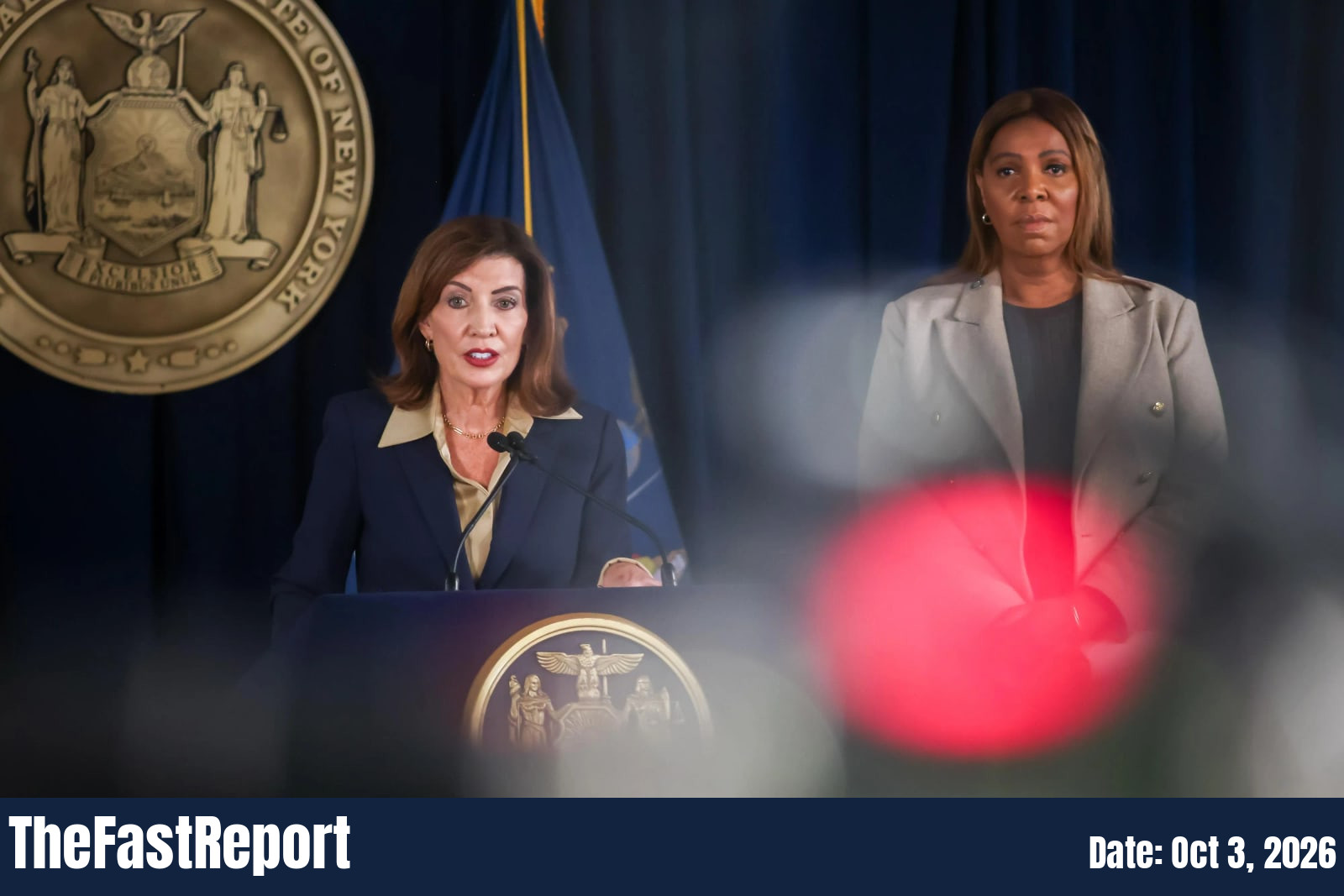
New York Gov. Kathy Hochul and New York Attorney General Letitia James at a news conference in New York City on October 2, 2026. | Michael Nagle/Bloomberg via Getty Images
In October 2024, Cornell University students received a campus crime alert about a reported sexual assault. At the time it was treated as a campus matter. Nearly two years later, on September 16, the victim identified as “Jane Doe” filed a civil lawsuit that brought national attention to her account, prompting questions about why criminal charges were not pursued.
Doe alleges that seven men drugged and sexually assaulted her at the Chi Phi fraternity house in 2024. Her suit also accuses Cornell University, fraternity and sorority organizations, and a local bar of failing to protect her.
Lawyers for several of the men have denied the allegations. Cornell says its disciplinary process produced suspensions and expulsions for some students and that the Chi Phi fraternity remains barred from campus.
Doe reported the incident to Cornell campus police in November 2024. The Tompkins County district attorney’s office reviewed her account and declined to bring criminal charges, with District Attorney Matthew Van Houten saying what she described to police didn’t meet New York’s requirements for criminal charges.
Van Houten reopened the investigation in late September 2026 while continuing to defend his original decision. On October 1, 2026, Gov. Kathy Hochul named New York Attorney General Letitia James as special prosecutor to investigate the allegations, saying she had “lost faith” in Van Houten.
To explain why the DA declined to pursue charges initially and what should have happened instead, Today, Explained co-host Noel King spoke with Lauren Hersh, a former Brooklyn prosecutor who led the office’s sex trafficking unit and is CEO of World Without Exploitation. Hersh discussed how authorities handled Jane Doe’s allegations, limits in New York’s consent laws, and what changes she believes are needed. The interview took place before James’s appointment.
Below is an edited excerpt of Hersh’s conversation with Noel King.
Noel King: I want to start with what we know in 2024. A young woman known as “Jane Doe” tells Cornell campus police she went to a frat house while intoxicated, was given more alcohol and ketamine there, and several men had sex with her while she was intoxicated. What is supposed to happen next?
Lauren Hersh: There is no one perfect scenario because it’s critically important to follow the survivor’s wishes and pace. The survivor should decide whether to speak to campus police, the Title IX office, or local law enforcement. But when prosecutors get a case file like this — including a six-page victim statement — that should be treated as a significant investigative lead. Good practice requires pulling back the layers: interviewing the victim, interviewing witnesses, and pursuing contemporaneous evidence like text messages and social media posts. In this case, that interviewing of the victim did not happen, and the prosecutor later said he didn’t know about text messages that were on a group thread. A timely investigation likely would have uncovered those messages sooner.
King: The DA has argued the details in the 2026 civil complaint differ from what the victim told police in 2024. Is that a valid defense?
Hersh: Leading with the idea of inconsistent statements risks blaming the victim. It’s common for inconsistencies to appear, and they’re not necessarily dealbreakers. To my knowledge, the DA had not interviewed the victim; the civil complaint is prepared with counsel and may reflect a fuller accounting. But the initial police statement appears to have been a summary of a conversation, not the end of an investigation.
King: What do you make of the DA doing press rather than investigative work?
Hersh: I find it confusing and troubling. It suggests the DA reached a conclusion before doing necessary investigative work like interviewing the victim and witnesses. That’s why I think the governor should consider appointing a special prosecutor — because the survivor deserves a full and fair investigation.
King: Drugs and alcohol are central to this case. How does New York law treat voluntary intoxication when assessing consent?
Hersh: New York law currently makes it difficult to prosecute cases where a victim was voluntarily intoxicated but not unconscious. Many advocates have long pushed to close this voluntary intoxication loophole. A change would allow prosecutors to bring cases when a victim is severely intoxicated but not physically helpless, and where a reasonable person should have recognized the victim’s condition. Based on what we’ve heard, Jane Doe appeared to be in a condition a reasonable person should have recognized. That makes this a very hard case under current law, but hard cases still deserve investigation and, where appropriate, prosecution. Legislative reform is critically important.
King: What further investigative steps would you seek now?
Hersh: The lapse of two years without immediate investigation is a major problem: evidence dissipates and memories fade, and campus narratives can take hold. Still, I believe an investigation is essential and that a special prosecutor should lead it. Investigators should interview everyone who was in the fraternity that night, anyone who saw the victim before or after, and anyone who made immediate statements afterward. They should collect all text messages and social-media correspondence from that night. Some newly disclosed messages, like one saying “Free pussy,” suggest a mindset inconsistent with consensual sex. Understanding the full contemporaneous record is critical to determining what happened.
King: Is this an isolated incident or a sign of systemic failure?
Hersh: This reflects both systemic and cultural failures. Sexual assault on college campuses is widespread, and this case shows prosecutorial and law-enforcement shortcomings I’ve seen in other work, including cases involving Epstein survivors. Immediate, thorough investigation is required, and we must do better to support survivors and pursue accountability.
Source: vox.com