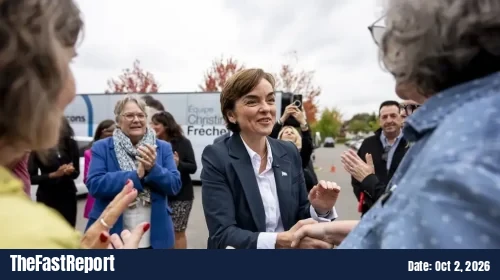


Quebecers have elected a sovereignist government, even though most residents do not support a separatist vote. Leader Paul St-Pierre Plamondon and the Parti Québécois (PQ) secured a minority government on Oct. 5, 2026, capitalizing on voter fatigue after eight years of Coalition Avenir Québec (CAQ) rule. St-Pierre Plamondon has insisted that a sovereignty referendum should be held within the first four years of a PQ mandate. Yet, three decades after the 1995 referendum, the historic political cleavage did not stop the party from taking power. In his victory speech in Montreal, St-Pierre Plamondon stated that the francophone struggle will find meaning once Quebecers achieve a country and recognition, framing it as a matter of justice, equity, and survival. Last December, former premier François Legault predicted the election would be a battle between the CAQ and the Quebec Liberal Party, believing St-Pierre Plamondon’s push for a referendum would sink his polls. However, Legault miscalculated the strong public desire for change. Throughout the campaign, St-Pierre Plamondon frequently asked voters if they really wanted 12 years of the CAQ. The result was a dramatic collapse for the CAQ, leaving the party with zero seats in the National Assembly. Sovereignty ultimately failed to function as an effective wedge issue, despite polls consistently showing that roughly 70 per cent of Quebecers oppose separation from Canada. The PQ formed its minority government with just 28 per cent of the popular vote due to the first-past-the-post electoral system, marking the lowest vote share for a winning party in provincial history and reigniting debates over electoral reform. St-Pierre Plamondon briefly addressed English-speaking residents during his speech, emphasizing shared challenges and a desire to collaborate on solutions. Given the timeline pushing a potential vote to 2029 or 2030, a referendum appears distant, and the fragile government leaves the premier on a short leash. Opposition parties like the Liberals and the Conservatives are positioned to block any legislation attempting to initiate a referendum. The CAQ’s freefall was highlighted by leader Christine Fréchette failing to win her riding. Fréchette took responsibility for the party’s defeat during her concession speech in Trois-Rivières, acknowledging the uphill battle of succeeding Legault after years of declining popularity. Her previous role as a prominent CAQ cabinet minister complicated efforts to present a fresh image. Meanwhile, the Conservative Party of Quebec achieved a historic breakthrough under Leader Éric Duhaime, who secured a seat in the Chaudière-Appalaches region alongside 19 total ridings, marking the party’s first elected seats in 90 years. It remains uncertain whether St-Pierre Plamondon will fulfill promises to reform the electoral system that propelled him to power.
Source: cbc.ca