

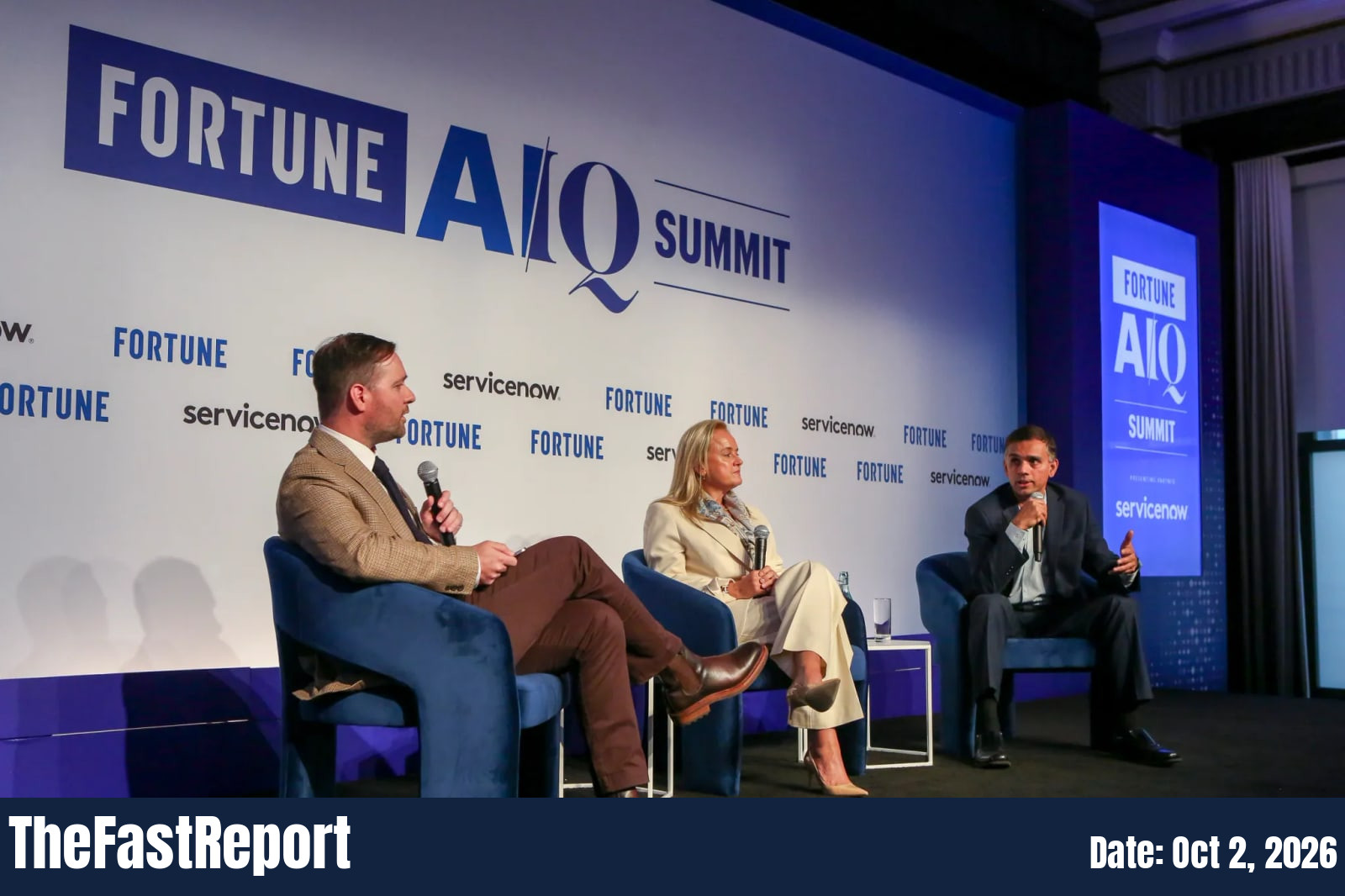
Good morning. In highly regulated industries, the question is not whether companies can deploy AI. It is whether they can trust it with decisions that affect customers, markets, and the broader economy.
At Fortune’s inaugural AIQ Summit on Thursday, Hari Gopalkrishnan, chief technology and information officer at Bank of America, and Sally Moore, chief client officer and co-head of market intelligence at S&P Global, described AI adoption as a discipline rooted in governance, data, and accuracy—not a race to attach the technology to every workflow. The discussion followed Fortune and ServiceNow’s release this week of the Fortune AIQ 75, an annual ranking of Fortune 500 companies generating measurable impact from AI.
At Bank of America, Gopalkrishnan said the company evaluates AI implementations across 16 risk dimensions, including privacy, bias, workforce implications and intellectual property. The starting point, he said, is not the model: “Start with the client need. Does AI actually answer the problem?”
“One of the biggest mistakes we see is rushing to AI as a solution when deterministic models can do the job just as well,” Gopalkrishnan said. The most expensive mistake may not be moving too slowly. It may be funding a sophisticated AI solution where simpler technology would yield a more reliable, lower-risk return.
When AI is warranted, he said, governance must be continuous: establishing guardrails, evaluating results and monitoring systems for unintended consequences. A fraud model that disadvantages certain demographic groups, or a chatbot that does not adequately serve customers with particular accents, creates customer, compliance and reputational risks—not merely a technology problem.
For S&P Global, the foundation is data. Moore said the company’s work with a Tier 1 bank demonstrates the operational value of combining proprietary intelligence, subject-matter expertise and implementation support. S&P Global helped the bank reduce its time to market by roughly sixfold and improve accuracy in work drawing on multiple data sets from about 60% to 98%.
But accuracy alone is not enough. “You need to be able to ensure that you can source the original IP that’s informing some of those decisions,” Moore said. In high-stakes applications, the ability to trace an AI-generated output back to the underlying data and intellectual property is essential.
Have a good weekend.
Sheryl Estrada
Sheryl.Estrada@fortune.com
This story was originally featured on Fortune.com
Source: fortune.com