
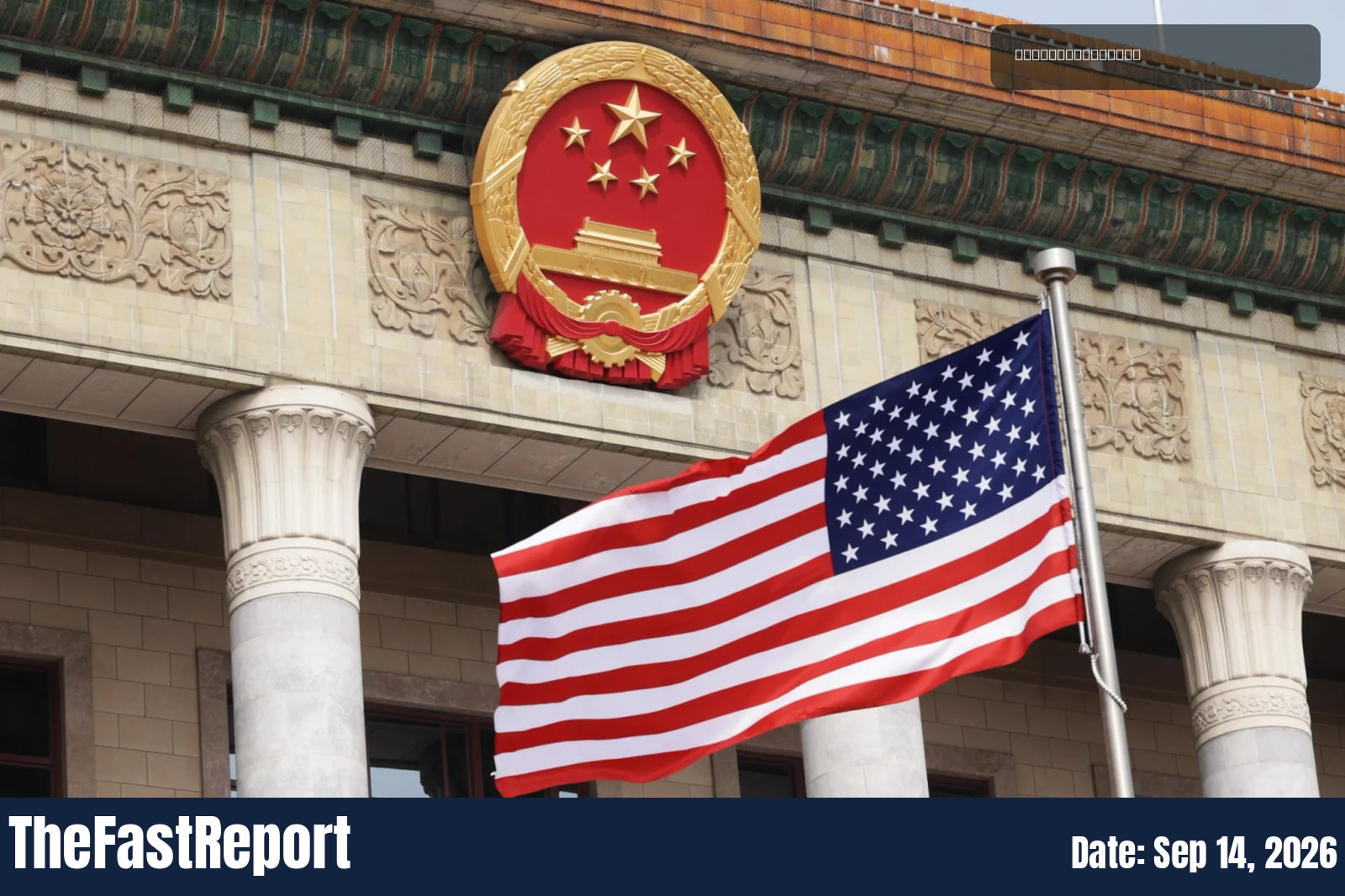
The rivalry between the U.S. and China over artificial intelligence intensified this week with new accusations and renewed questions about how Chinese labs closed the performance gap with American rivals.
U.S. officials alleged earlier this week that six Chinese AI companies found a shortcut: buying bulk subscriptions to American models and training on their outputs. The FBI, the National Security Agency, and the Cybersecurity and Infrastructure Security Agency said Tuesday that DeepSeek, Moonshot, and four other firms extracted “capabilities worth billions” using this approach since 2024, a method the agencies said allowed DeepSeek to understate its $5.6 million training cost.
China’s foreign affairs ministry rejected the claims, saying the country’s AI development “is a result of high-level scientific and technological self-reliance” and calling the accusations “groundless.”
The allegations offer one explanation for why some estimates now place Chinese models close to U.S. counterparts: a Stanford report put Anthropic’s top model ahead of DeepSeek’s by just 2.7% earlier this year. But analysts point to a different reason Chinese labs have narrowed the gap — they have become far more efficient with the resources they have.
More value for fewer tokens
Chinese teams have refined techniques tied to “attention,” the mechanism introduced in a landmark 2017 paper that underpins large language models. Attention lets a model weigh each piece of text against others to find the most relevant connections, but the computation grows more expensive as context windows lengthen.
Brendan Burke, a semiconductors and supply chain analyst at Futurum Group, told Fortune that Chinese labs discovered algorithmic shortcuts that make attention calculations cheaper and more efficient. “Chinese labs found algorithms that reduce the complexity of those calculations by an order of magnitude, and then achieve better results because they’re able to summarize the most relevant tokens,” he said.
Necessity pushed the work. U.S. restrictions on China’s access to Nvidia’s best chips steered Chinese developers toward domestic alternatives like Huawei, limiting access to the highest-performing compute available in the U.S. At the same time, a White House report found the U.S. controls 74% of the world’s compute, and hyperscalers in the U.S. continue to invest heavily in data centers.
“Because they had less compute to work with, they found that computationally efficient method instead of just throwing more compute at an inefficient technique, as U.S. labs initially did,” Burke said about China. By contrast, he added, U.S. frontier labs can be “token hogs” because their systems are designed to be exploratory and to test base models.
The trade-off shows up in enterprise usage. Ameya Kanitkar, cofounder of AI measurement platform Larridin, told Fortune that in workflows Larridin tracks, Chinese models such as GLM 5.2 and Kimi 2.6 and 2.7 handle around 75% of engineering tasks “reasonably well” at about a fifth of the cost of U.S. models. “Frontier U.S. models still have an advantage on the most complex tasks, but Chinese open-weight models are becoming more than capable enough for the majority of everyday enterprise engineering work,” Kanitkar said.
The cost difference may matter as AI spending takes up a larger share of corporate budgets: a McKinsey survey found 20% of business leaders saying AI-related costs like buying tokens constrain their use of AI.
U.S. enterprises warming up to Chinese models
Cost-efficiency is not the only draw. DeepSeek’s R1 reasoning model was made available for download through platforms like Hugging Face, letting companies run and adapt versions locally. That openness lets firms fine-tune models without relying solely on closed services, and some run those models through U.S.-based cloud providers.
That flexibility has encouraged some U.S. businesses to try Chinese models while limiting concerns about sending data directly to China-based firms. Hugging Face reported that Chinese open-source models accounted for 41% of total downloads last year, a larger share than U.S. models.
DoorDash CEO Andy Fang said using Moonshot AI’s Kimi was “cheaper” and “better quality” without degrading the quality of code. AI coding startup Cursor used Kimi to help build its Composer 2 coding agent. Airbnb and Siemens are also experimenting with Alibaba and DeepSeek models, with Airbnb CEO Brian Chesky calling Qwen “fast and cheap.”
Chinese models are also being adopted for specialized tasks. Thomson Reuters said it adapted Alibaba’s open-source Qwen into an in-house model, Thomson-1, to handle document-review work previously done by Claude.
Data indicate a visible enterprise shift: Ramp’s AI index showed the share of businesses paying for platforms with access to open-source and Chinese-developed models rose to 6.1% of total AI-spending businesses in July from 4.5% in January.
Still, using Chinese models does not mean U.S. models are being abandoned. U.S. companies remain ahead on the cutting edge: they are “still months ahead in performance,” according to some analyses. Mike Finley, chief technology officer of AnswerRocket, told Fortune the outputs of U.S. AI companies provide the “existence proof” that enables Chinese labs to innovate. “The work they do would simply not be possible without the frontier labs blazing the trail,” Finley said.
This story was originally featured on Fortune.com
Source: fortune.com