
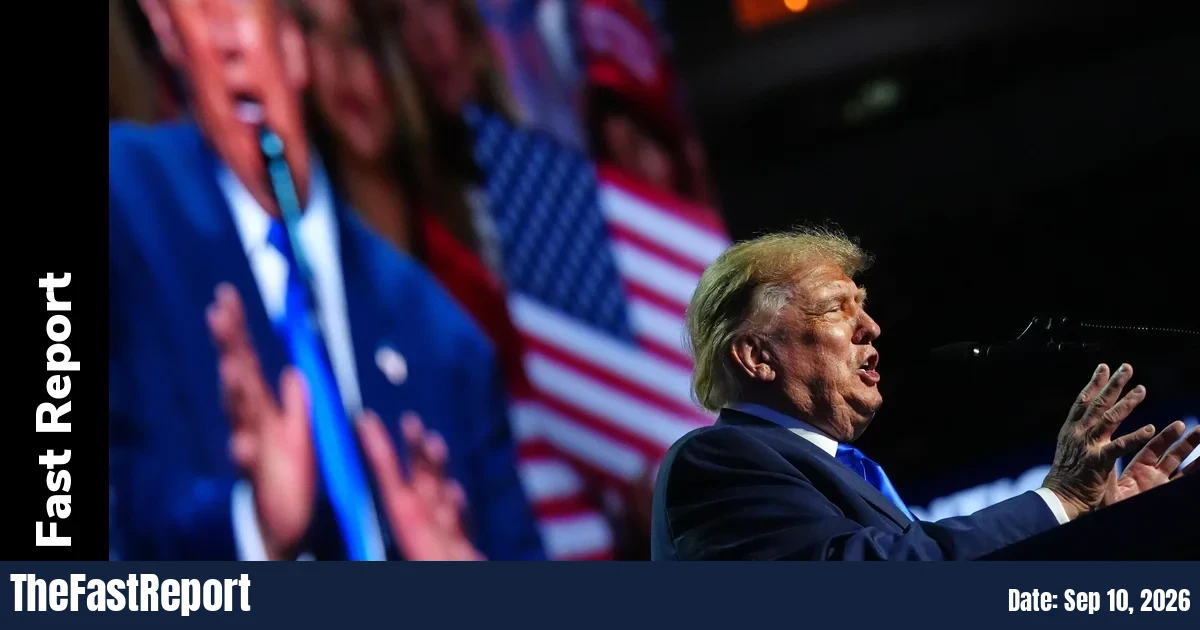
President Trump announced a promise to provide every American adult with $5,000 should Republicans maintain control of the House and Senate in November, describing the proposal as a dividend funded by the nation’s robust economy. Speaking at the Republican National Committee’s midterm convention, the president’s pledge faces significant political and logistical challenges, echoing previous universal cash payout promises that largely failed to materialize, aside from Trump Accounts established for babies born during his administration. According to the Census Bureau, the United States has approximately 245 million citizens aged 18 and older, bringing the total cost of a $5,000 payout to more than $1.2 trillion. CBS News reached out to the White House to request specifics regarding the proposal, including how the funds would be distributed. Executing this payout would necessitate congressional approval. With Republicans currently holding both chambers, the administration could have already pushed for legislative action or drafted a bill to demonstrate commitment and build voter support. Nevertheless, congressional GOP leaders have shown hesitation toward a policy that would expand the national debt, which exceeded $40 trillion the previous month, while House Speaker Mike Johnson has committed to pursuing spending cuts following the midterms if the party retains power. Current polling suggests it will be difficult for Republicans to hold both chambers, as the party encounters headwinds in the House where a small number of lost districts would forfeit the majority, and Democrats hold an advantage on the generic ballot. A Democratic-led House or Senate would almost certainly reject the $5,000 payments. Earlier in his term, the president expressed interest in ‘DOGE dividends’ when billionaire Elon Musk led efforts to reduce government size. Addressing the FII Priority Summit in Miami in February of last year, Mr. Trump mentioned evaluating a concept to distribute 20% of DOGE savings to citizens and allocate another 20% toward debt reduction. Ultimately, DOGE savings fell short of expectations, and the initiative stalled. The president similarly promised tariff dividends last year, suggesting individuals—excluding high earners—would receive at least $2,000 each. Direct payments to taxpayers have not occurred. Instead, corporations have received tariff refunds following a Supreme Court ruling that deemed specific Trump tariffs illegal. Although certain companies expressed intentions to pass financial relief along to consumers, they are under no obligation to do so. Vice President JD Friendly noted to Fox News that the funds would originate from tariff revenue, yet current revenue generation falls short of supporting such a program. Total tariff collections are far below the $1.2 trillion required to disburse $5,000 to every adult citizen. Data from the Bipartisan Policy Center indicates that gross tariff and excise taxes brought in approximately $210 billion in 2026, translating to about $857 per eligible individual, and a significant portion of this revenue has already been paid back to corporations as refunds. The Bipartisan Policy Center notes that more than half of 2026 tariff revenues have gone toward corporate refunds. Furthermore, the Cato Institute calculates that issuing $5,000 checks to every American adult would consume between 60% and 75% of all projected revenue generated by the administration’s tariffs over a 10-year span.
Source: cbsnews.com