
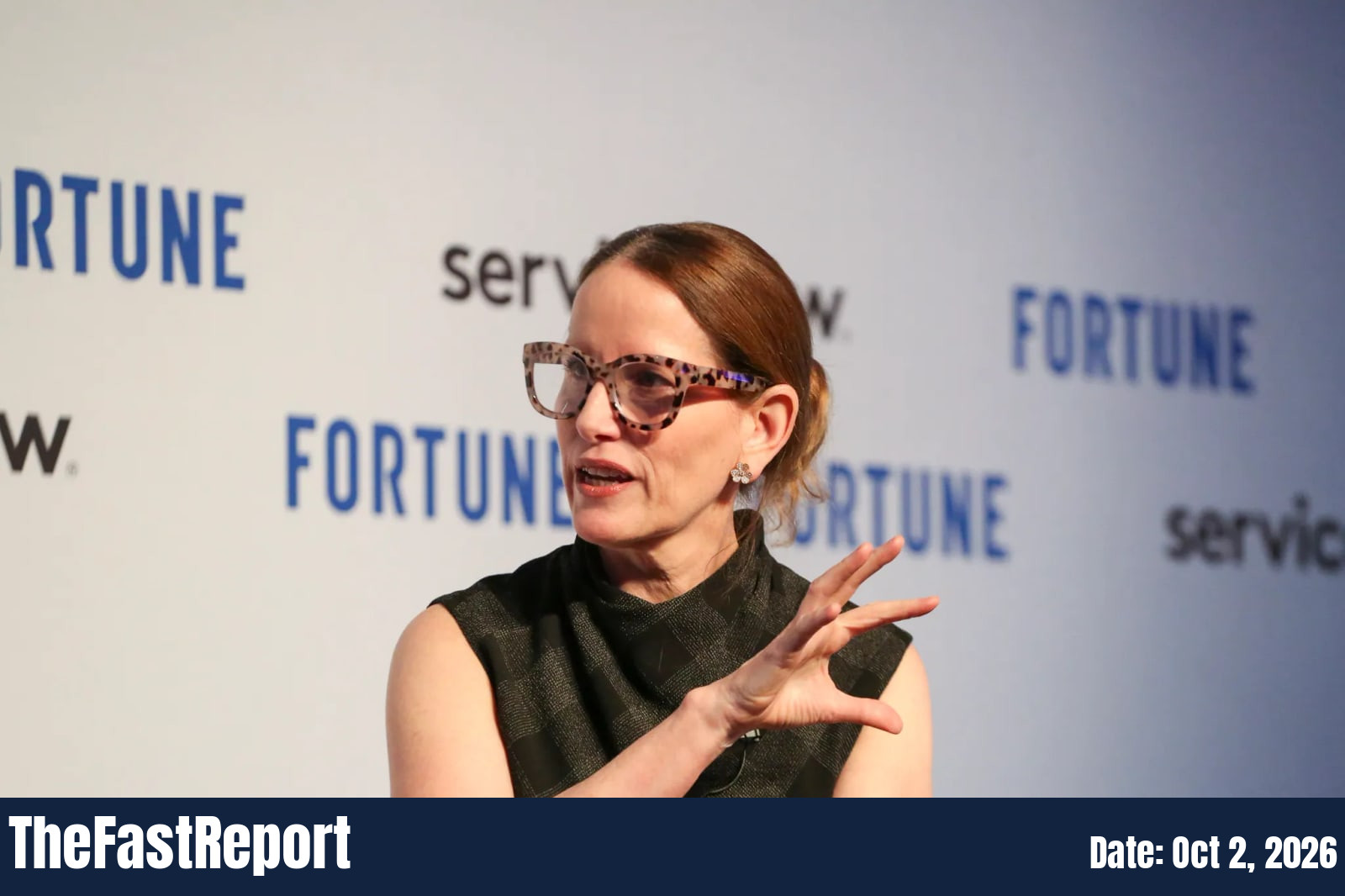
Diana David describes herself as a “forward-deployed futurist.” She said CEOs wanted “forward-deployed” employees—people “to be out on the edge, to bring us back the insights about what is actually happening in AI in our companies.”
At the Fortune AIQ Summit on Thursday, David, ServiceNow’s director of futures, said the biggest differences between companies leading in AI and the rest are not mainly about technology but about people.
“Talent investment. That was the biggest gap,” David told moderator Jeremy Kahn, Fortune’s AI editor. According to ServiceNow’s Enterprise AI Maturity Index, 57% of “pacesetters” invest in ongoing AI upskilling, compared with 4% of other organizations. The single largest gap is in attracting, hiring, and retaining AI talent: 68% of pacesetters versus 10% of others.
“It’s really operational discipline, right?” David said. “It’s not just technology—operational discipline and transformation.”
Pacesetters, roughly 21% of surveyed organizations that scored above 60 on the 100-point index, averaged 74 on the index versus 45 for the rest. Their advantages extend beyond talent: 64% of pacesetters are on a path to unified data versus 14% of others, and 57% have “a clear, strong AI vision,” versus 21%.
David discussed autonomous workflows: about 59% of companies surveyed are past the pilot phase, but only 9% are running agentic, autonomous, multistep workflows that aren’t checked by humans at every step. Among pacesetters, 36% have such workflows compared with 2% of other firms. “These workflows are not just one little point of sale,” she said.
That gap underlies what David called her “pet peeve”: broad AI adoption without depth. “I get it, because it’s a great CEO story,” she said. “95% of everybody has X, Y, Z. But it is not translating into productivity, and it’s often not with training, and that doesn’t equal maturity.”
Kahn framed the problem: many companies handed employees AI tools and “let a thousand flowers bloom,” then found it costly and not clearly productive, so they narrowed initiatives to specific use cases. Some organizations dropped agents into existing workflows or replaced an employee with one.
David said change must start with leadership. “I think it starts with leadership,” she said. “Growth mindset, an idea, and a vision for change of what the company can become, followed with specific training around AI and specific functions.”
She encouraged executives to adopt a “day zero mentality” about designing processes from scratch rather than “sprinkling AI on something, probably a very old or broken process, to make it go even faster.” That, she said, doesn’t solve the underlying problem.
Kahn raised a common executive concern: technology moves so fast that redesigned processes may be obsolete within a year. David’s response: have a vision, align data, choose workflows, assign ownership, and iterate. “I don’t think that any company is going to succeed by doing some kind of top-down plan where one person or one strategy team is redesigning everything immediately,” she said.
She cited ServiceNow’s AI Control Tower as a tool for organization-wide visibility. “You have to have transparency,” she said. “Having the visibility from across the organization and a very strong foundation allows you to be flexible.”
On the human side, most companies lag. The report finds 59% of organizations lack long-term HR plans for AI, and 42% of employees say they aren’t getting enough AI training. The report also puts pacesetters’ average ROI at 160%.
Leaders are not limited to tech firms. David said technology companies filled about one in five spots on Fortune’s AIQ 75, followed by financial services. Construction and engineering accounted for six spots, and food and health care five each. “It is everything, everywhere, all at once,” she said.
The index has been volatile. “In 2024 we started this, and we thought, ‘It’s just going to go up and up and up,’” David said. The average score then fell from 44 to 35, a drop David attributed to widespread AI noise that hadn’t translated into company value. Scores rebounded to 51 this year. “I can’t promise you that there won’t be another dip next year,” she added.
ServiceNow plans to add agentic AI to the AIQ next year, shifting measures to include “what are we deploying and where,” and whether companies are “realizing actual commercial value.” David said that will better define true business maturity, compared with simply having “AI in their pocket.”
For this story, Fortune journalists used generative AI as a research tool. An editor verified the accuracy of the information before publishing.
This story was originally featured on Fortune.com
Source: fortune.com