
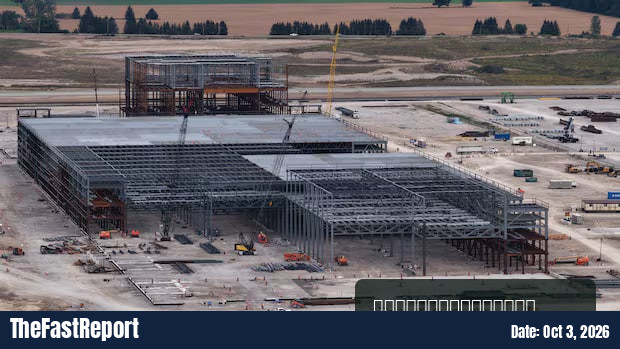
Federal and provincial governments poured billions into building a domestic electric vehicle and battery manufacturing sector. However, major projects across Ontario, Quebec, and British Columbia have faced delays, cancellations, suspensions, or restructuring as automakers grapple with slower-than-expected demand. The latest setback involves Volkswagen’s massive PowerCo battery facility in St. Thomas, Ontario, which has delayed its production start by two years to 2029 due to evolving market conditions. These hurdles have intensified debates over whether governments miscalculated the growth pace of the EV market. Critics argue that consumer demand may never catch up to the massive production capacities that public funds helped attract, while supporters maintain these hurdles are simply short-term growing pains within a long-term electrification trend. Grieg Mordue, a former Toyota executive and retired McMaster University professor, noted that the St. Thomas facility highlights fundamental concerns regarding scale and geographic location. When announced in 2023, the plant was projected to produce enough battery cells for roughly one million electric vehicles annually. Mordue pointed out that this output seemed inefficient given that Volkswagen’s primary vehicle assembly operations are located in the southern United States and Mexico, requiring batteries to be transported over vast distances. Furthermore, Volkswagen already maintains battery production capabilities in Europe. Even combined, the automaker’s North American plants do not manufacture enough vehicles to naturally absorb a million batteries each year. Although Volkswagen delayed production, the company reaffirmed that the facility remains a core component of its North American strategy, noting that the timeline adjustment enables the integration of newer battery technologies. Mordue added that the delay could financially benefit taxpayers by reducing total subsidy outlays, since public support is tied to actual production volumes scheduled to phase out by 2032. Innovation, Science and Economic Development Canada reported that the federal government has contributed $700 million to the construction phase so far, with Ontario funding a third of the total $13.2 billion agreed upon for production incentives. Conversely, advocates like Clean Energy Canada policy director Joanna Kyriazis argue that evaluating the sector based on short-term demand overlooks the multi-decade lifespan of such industrial infrastructure. Kyriazis views the current slowdown as a transitional phase rather than an indicator of overcapacity, emphasizing that domestic manufacturing is vital to keeping Canada competitive in the global automotive landscape. Recent data from Statistics Canada shows potential signs of recovery, with battery-only EV registrations rising 37.4 per cent in the second quarter of 2026 compared to the previous year. Meanwhile, skeptics like University of Guelph economics professor Ross McKitrick remain doubtful that time will resolve the market mismatch. McKitrick contends that governments attempted to force an oversized market into existence through heavy corporate and consumer incentives that do not reflect organic economic sustainability. Transport Canada figures show that electric vehicles accounted for 11.7 per cent of new light-duty sales during the first quarter of 2026, marking a decrease from a peak of 15.4 per cent in 2024.
Source: cbc.ca